
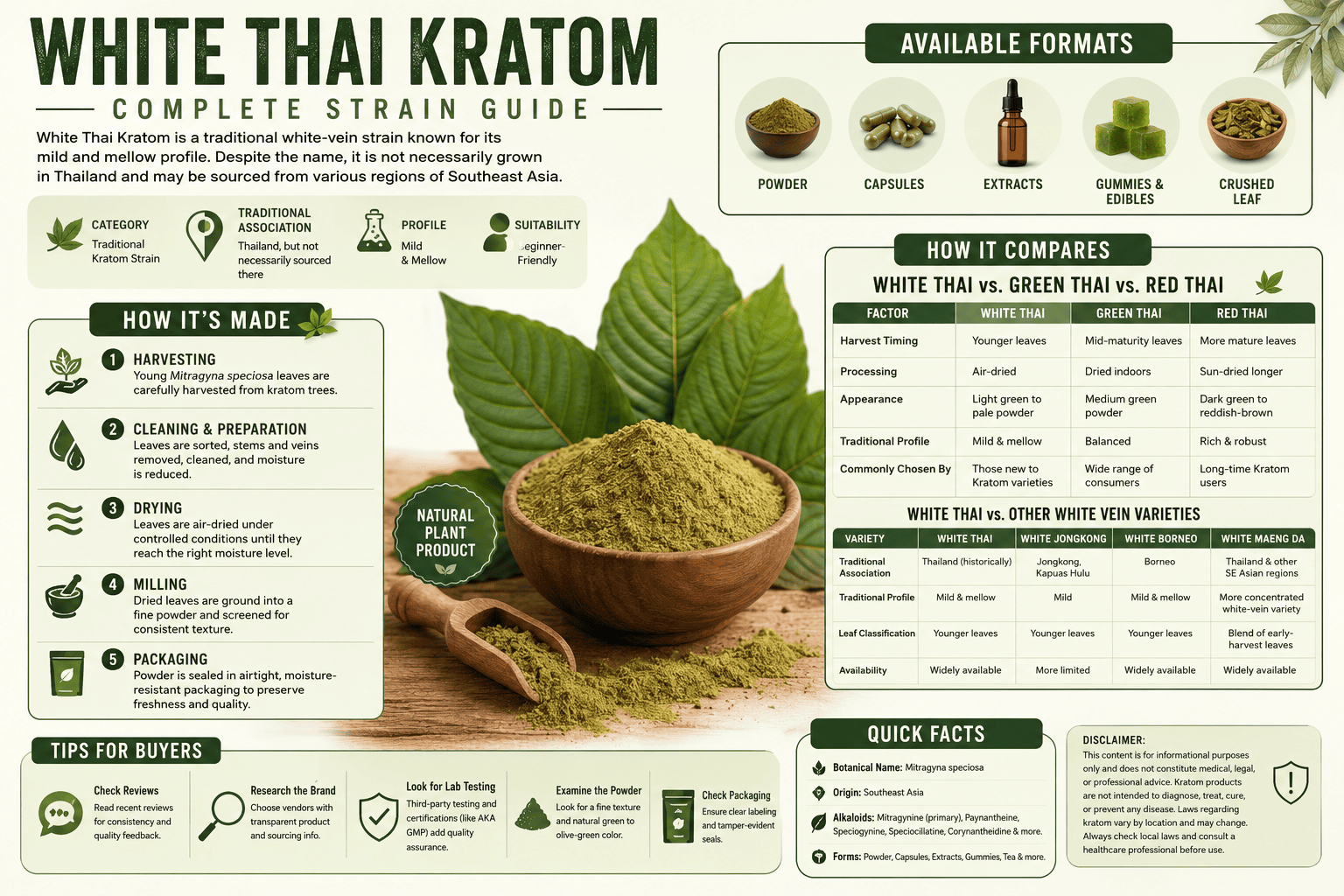
🌱 Category: Traditional Kratom strain
📍 Name: Traditionally associated with Thailand, but not necessarily sourced there
🧪 Profile: Mild and mellow
👤 Suitability: Beginner-friendly
📦 Forms: Capsules, powder, tablets, tea, loose leaf, extracts
White Thai Kratom is a traditional white-vein Kratom strain made from the leaves of the Mitragyna speciosa tree. Despite its name, White Thai Kratom is not necessarily grown or harvested in Thailand. The name is historically associated with Thailand, while products sold today may be sourced from different regions across Southeast Asia.
In this complete White Thai Kratom guide, we’ll explore the strain’s origin, characteristics, available forms, and production process. We’ll also compare White Thai Kratom with other popular white-vein Kratom strains and explain what to consider when deciding whether buying White Thai Kratom is the right option for you.
What Is White Thai Kratom?
White Thai Kratom is a naturally occurring strain that has a milder alkaloid profile. The chemical composition of White Thai Kratom includes several natural alkaloids, with Mitragynine generally making up the largest share of its overall profile.
Primary Alkaloid
Mitragynine: In classic Thai Kratom profiles, Mitragynine has been reported to account for up to 66% of the total alkaloid content. However, the exact percentage can vary between plants, batches, and products.
Secondary and Supporting Alkaloids
The remaining alkaloid profile may include several secondary indole and oxindole compounds, including:
Paynantheine
Speciogynine
Speciociliatine
Corynantheidine
👉 Note: The specific concentration of these alkaloids can vary depending on the plant's genetics, growing conditions, harvest timing, and processing methods.
How Is White Thai Kratom Made?
White Vein Thai Kratom is produced through a carefully controlled process that typically includes harvesting, drying, processing, quality testing, and packaging.
Here’s a step-by-step process:
1. Harvesting
Young Mitragyna speciosa leaves are carefully harvested from Kratom trees grown in the lush tropical regions of Southeast Asia.
2. Cleaning and Preparation
Once harvested, the leaves are sorted and prepared for the next stage of processing. Large stems and central veins are typically removed, while the leaves are cleaned to remove dirt and other unwanted particles. Any excess moisture is then removed before the drying process begins.
3. Drying
The prepared leaves are spread out and allowed to dry in open air under controlled conditions. Drying continues until the leaves reach the appropriate moisture level for milling.
4. Milling
After drying, the leaves are processed into a fine powder. The milled material may be screened to separate larger particles and create a more consistent texture.
5. Packaging
The finished White Thai Kratom powder is packed in airtight, moisture-resistant containers or pouches. Proper packaging helps protect the product from moisture and exposure to air during storage and transportation.
White Thai Kratom Formats: What Are Your Options?
White Thai Kratom is available in several product formats, allowing buyers to choose between traditional leaf-based products and more concentrated formulations.
Format | What It Is |
Finely milled dried White Thai Kratom leaves in loose powder form. | |
Capsules filled with White Thai Kratom powder for convenient use. | |
Liquid Extracts | Concentrated liquid formulations made by extracting naturally occurring plant alkaloids. |
Extract Powders | Concentrated powdered formulations made from processed Kratom material, often labeled with strengths such as 10x or 50x. |
Chewable products infused with White Thai Kratom extract, often formulated to mask the plant's natural flavor. | |
Crushed Leaf | Coarsely ground Kratom leaves that can be used to prepare traditional teas or infusions. |
👉 Looking for White Thai Kratom in different formats? Explore the available product range at Durity Distribution.
White Thai vs. Green Thai vs. Red Thai: How Do They Compare?
White Thai, Green Thai, and Red Thai are all traditional Kratom varieties associated with different leaf colors and processing approaches.
Factor | White Thai | Green Thai | Red Thai |
Harvest Timing | Typically associated with younger leaves | Generally linked to leaves harvested at mid-maturity | Commonly associated with more mature leaves |
Processing | Air-dried under controlled conditions | Dried indoors with little to no light | Sin-dried for longer duration |
Appearance | Light green to pale powder | Medium green powder | Dark green to reddish-brown powder |
Traditional Profile | Mild and mellow | Balanced and versatile | Rich and robust |
Available Forms | Powder, capsules, extracts, and more | Powder, capsules, extracts, and more | Powder, capsules, extracts, and more |
Commonly Chosen By | Those new to Kratom varieties | A broad range of consumers | Long-time users of Kratom products |
White Thai vs. Other White Vein Kratom Varieties
Here's a side-by-side comparison of White Thai with White Jongkong, White Borneo, and White Maeng Da.
Factor | White Thai | White Jongkong | White Borneo | White Maeng Da |
Traditional Association | Traditionally Thailand and now broader Southeast Asia | Jongkong, Kapuas Hulu | Borneo | Traditionally associated with Thailand and other Southeast Asian regions |
Traditional Profile | Mild and mellow | Mild | Mild and mellow | Often described as a more concentrated or specialized white-vein variety |
Leaf Classification | Younger leaves | Younger leaves | Younger leaves | A blend typically made from at least two varieties of early-harvest leaves. |
Availability | Widely available | More limited | Widely available | Widely available |
How To Choose High-Quality White Thai Kratom: Tips For Buyers
No White Thai Kratom guide is complete without a few practical tips for evaluating product quality before making a purchase. Here are some key factors to consider:
Review recent White Thai Kratom reviews: Look for feedback on product consistency, quality, and overall customer experience.
Research the brand: Choose vendors that provide clear details about their products and sourcing practices.
Look for independent testing: Third-party lab testing and recognized certifications, such as AKA GMP Qualified Vendor status, can provide additional quality assurance.
Examine the product's appearance: A quality powder generally has a fine, consistent texture and a natural green to olive-green color.
Check the packaging and label: Look for clear product information and tamper-evident seals.
Frequently Asked Questions
1. Is White Thai Kratom legal?
Yes, White Thai Kratom is legal in the US. Kratom laws vary by country, state, and local jurisdiction. Check current laws where you live before buying.
2. How should White Thai Kratom be stored?
Store White Thai Kratom in a cool, dry place away from direct sunlight, heat, and moisture. Airtight packaging can help protect the product during storage.
3. Where can I find White Thai Kratom near me?
White Thai Kratom may be available at nearby smoke shops, gas stations, specialty retailers, and health and wellness stores. Availability varies by location and local regulations.
4. Can you trust the quality of White Thai Kratom from a smoke shop?
Quality can vary between retailers. Check the product label, batch information, testing documentation, and manufacturer details rather than relying solely on where the product is sold. If you prefer buying online, choose a reputable supplier such as Durity Distribution that provides clear product information and sourcing details.
5. Does White Thai Kratom expire?
Kratom products can gradually lose quality over time, particularly when exposed to moisture, heat, air, or sunlight. Check the manufacturer's expiration or best-by information when available.
6. Can White Thai Kratom be shipped to my location?
Shipping availability depends on applicable federal, state, and local laws, as well as the seller's policies. Check current regulations before placing an order.
Disclaimer: This article is for informational and educational purposes only and does not constitute medical, legal, or professional advice. Kratom products, including White Thai Kratom, may affect individuals differently. Laws and regulations regarding Kratom vary by location and may change over time. Always check current local laws and consult a qualified healthcare professional before using Kratom or any botanical product.