
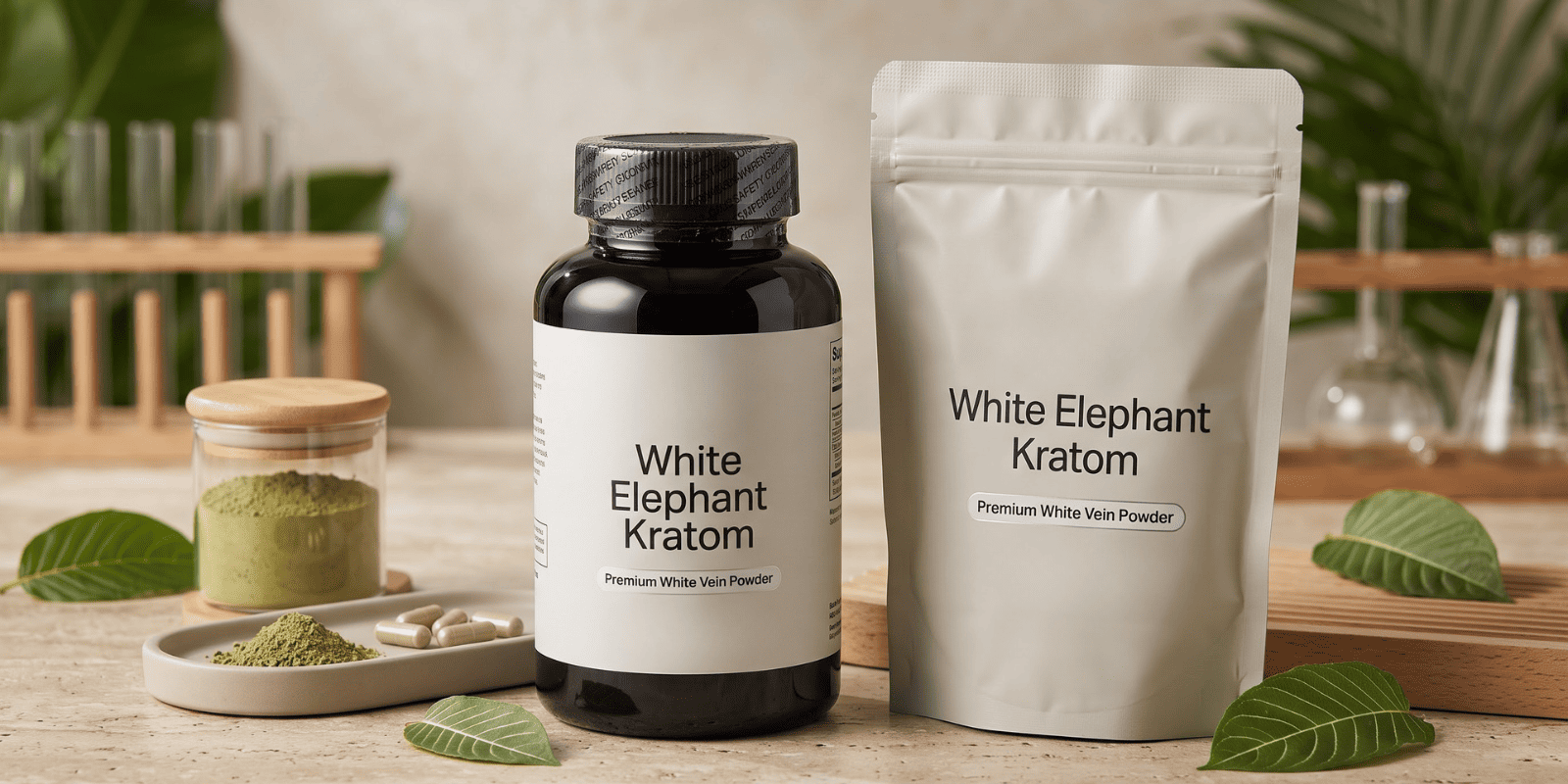
 White Elephant Kratom is a white-vein strain named after big, droopy leaves that resemble elephant ears. It is traditionally associated with daytime use. But is that all there is to this unique Kratom strain?
In this White Elephant Kratom review, we’ll explore the strain’s origins, alkaloid profile, popular formats, and how White Elephant compares to other white-vein Kratom varieties. Let’s get started.
Quick Overview:
Origin: Tropical rainforests of Southeast Asia
Leaf Type: White-vein strain with large, elephant-ear-shaped leaves
Plant Maturity: Typically associated with more mature leaves
Alkaloid Profile: Often described as having a higher concentration of alkaloids than other White-Vein Kratom varieties
Table of Contents:
What Is White Elephant Kratom?
Where Does It Come From?
How Is White Elephant Kratom Made?
White Elephant Kratom: Available Formats
White Elephant Vs Other White Vein Varieties
How To Choose The Best White Elephant Kratom?
Frequently Asked Questions
What Is White Elephant Kratom?
White Elephant Kratom comes from large, mature Mitragyna speciosa leaves with distinctive white veins and an elephant-ear-like shape. Unlike many white-vein varieties made from younger leaves, White Elephant is made from mature leaves and dried using specific techniques, including indoor, UV-free drying.
The combination of mature leaf size and specialized drying methods makes White Elephant Kratom stand apart.
Where Does It Come From?
White Elephant Kratom comes from the tropical regions of Southeast Asia, including Indonesia, Thailand, and Malaysia. The Mitragyna speciosa tree is also native to Borneo and Sumatra, two regions known for their tropical, humid environments.
How Is White Elephant Kratom Made?
The process focuses on minimizing oxidation, retaining alkaloids, and controlling temperature and moisture.
UV-Free Drying
White Elephant: Typically dried indoors in dark, fan-assisted rooms or controlled UV-light systems.
Why it matters: Limiting natural sunlight helps reduce oxidation and preserve mitragynine content.
Alkaloid Retention
Mature leaves: White Elephant leaves are large and fully developed, providing a strong alkaloid profile.
Indoor air-drying: Helps minimize alkaloid degradation caused by sunlight and excessive heat.
Key alkaloids: Mitragynine, speciogynine, and paynantheine are among the compounds preserved during controlled drying.
Temperature & Moisture Control
Drying temperature: Typically maintained around 25°C to 40°C in climate-controlled facilities.
Low, controlled temperatures: Help limit heat-related degradation of secondary alkaloids.
Controlled environment: Managing temperature, airflow, and moisture creates a more consistent drying process than unpredictable outdoor conditions.
Milling
Once fully dried, the leaves are milled into a fine powder for easier handling and consistent formulation.
It helps create a uniform texture and particle size across the finished product.
Lab Testing
Finished White Elephant Kratom may undergo third-party laboratory testing to assess its alkaloid profile and overall quality.
Testing can screen for contaminants, heavy metals, microbes, and other unwanted substances.
Note: Processing and drying methods can vary by vendor, which may affect the product's final characteristics.
White Elephant Kratom: Available Formats
White Elephant Kratom is commonly available in three main formats: powder, capsules, and liquid extracts. Each format differs in convenience, taste, and packaging.
1. White Elephant Kratom Powder
The traditional and most common format.
Form: Finely milled White Elephant Kratom leaf
Pros: Cost-effective and easy to customize
Cons: Has a naturally bitter, earthy taste
Best For: Mixing into beverages or preparing tea
2. White Elephant Kratom Capsules
Capsules contain pre-measured White Elephant Kratom powder inside a gelatin or vegetable-based shell.
Form: Powder-filled capsules
Pros: Convenient, portable, and taste-free
Cons: Generally costs more than loose powder
Best For: People looking for a mess-free, convenient format
3. Liquid Extracts
These are concentrated liquid shots made by processing White Elephant Kratom to extract its alkaloids.
Form: Liquid extracts or shots
Pros: Compact and convenient
Cons: Typically more concentrated and may cost more than powder
Best For: On-the-go moments.
Note: Availability, processing methods, and product strength can vary by vendor. Always check the product label and available lab-testing information before purchasing.
White Elephant Vs Other White Vein Varieties
Here’s a quick comparison of White Elephant and other popular white-vein varieties, highlighting where they come from and what sets each one apart.
Name | Origin | How They Differ |
White Elephant | Southeast Asia, particularly Indonesia, Thailand, and Malaysia | Known for its large, elephant-ear-shaped leaves and processing methods that commonly involve mature leaves and controlled drying. |
Borneo, including Indonesia, Malaysia, and Brunei | Sourced from the Borneo region and generally associated with standard-sized leaves rather than the oversized leaves linked to White Elephant. | |
Indonesia | A wide Indonesian variety often described as more moderate and balanced than faster white-vein varieties. | |
Malaysia | Traditionally associated with Malaysian cultivation and commonly distinguished by a smoother, more gradual profile than White Elephant. | |
Traditionally linked to Vietnam’s Mekong River region | Considered a rarer variety and distinguished by its traditional Vietnamese origin and specialized growing environment. |
How To Choose The Best White Elephant Kratom?
A quick look at a few key details can make choosing easier. Here’s what to look for:
Check the source: Look for clear origin and sourcing details.
Review lab testing: Choose products with third-party COAs.
Check the alkaloid profile: Look for transparent, batch-specific testing.
Read the reviews: Check recent reviews and Kratom forums for genuine feedback.
Choose transparent vendors: Look for clear labeling and quality information.
Frequently Asked Questions
1. Is White Elephant Kratom rare?
No, White Elephant Kratom is not genuinely rare, although vendors often market it as a special or hard-to-find variety. Moreover, availability varies by supplier and region.
2. Can White Elephant Kratom vary between batches?
Yes. Natural variation in the plant, growing conditions, harvest, and processing can lead to differences between batches from the same supplier.
3. How should White Elephant Kratom be stored?
It should generally be kept sealed, dry, and away from direct sunlight and excessive heat to help maintain product quality during storage.
4. Can I legally buy White Elephant Kratom in the US?
Yes, you can legally buy White Elephant Kratom as it is not federally scheduled in the US. However, Kratom laws vary by state and local jurisdiction. Buyers should check current regulations in their location before purchasing.
5. Can I buy White Elephant Kratom in bulk?
Yes. White Elephant Kratom is available in bulk through Durity Distribution, with a $500 minimum order quantity (MOQ).
Related Reads:
Disclaimer: Kratom laws and regulations vary by location and may change over time. Product characteristics, processing methods, and lab results can also vary by vendor and batch. Always check local regulations and product information before purchasing.