
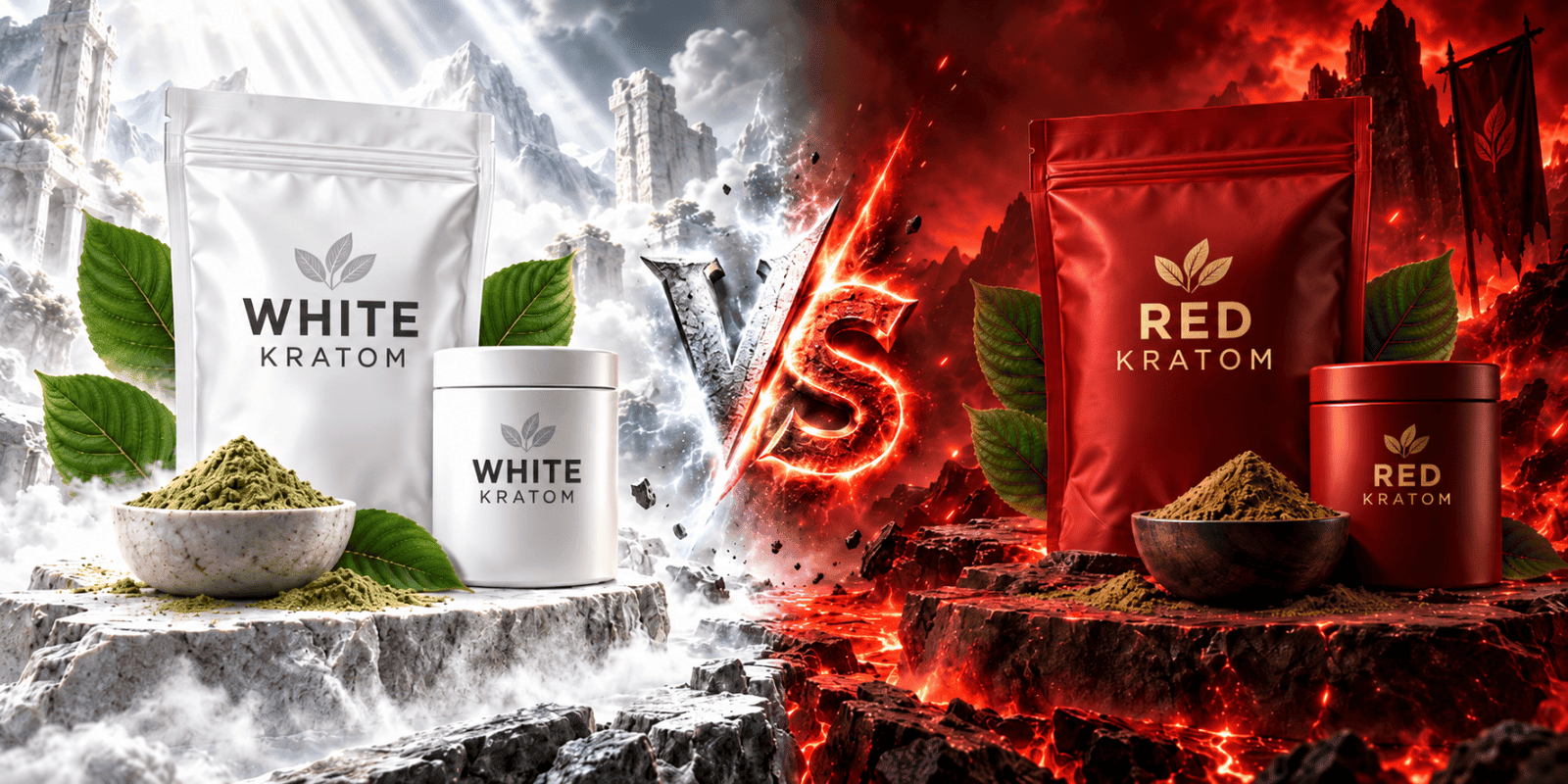
 Have you heard about the ongoing White Kratom vs Red Kratom debate? Instead of clearing up your questions, has it left you even more confused? Don’t worry, we’ve got you covered.
White Kratom and Red Kratom are both varieties of Mitragyna speciosa, but they can differ in leaf maturity, processing methods, and alkaloid profiles. In this Red Kratom vs White Kratom guide, we’ll break down these differences to give you a clearer picture of how the two varieties differ.
White Kratom vs Red Kratom: Quick Comparison
Feature | White Kratom | Red Kratom |
Plant Source | Mitragyna speciosa | Mitragyna speciosa |
Leaf Maturity | Younger leaves | Mature leaves |
Color | White or pale green | Red or reddish-brown |
Alkaloid Profile | Mild | Potent |
Available Formats | ||
Commonly Chosen By | Often considered a beginner-friendly variety | Often preferred by more experienced consumers |
Table Of Contents:
What Is White Kratom?
What Is Red Kratom?
White Kratom vs Red Kratom: Key Differences
Final Thoughts
Frequently Asked Questions
What Is White Kratom?
White Vein Kratom is generally made from the young leaves of Mitragyna speciosa, a plant native to Southeast Asia. The leaves are harvested, dried in open-air under controlled conditions, and then ground into a fine powder. It is traditionally described as a popular daytime variety.
👉 Popular varieties: White Kali, White Thai, and White Borneo.
What Is Red Kratom?
Red Vein Kratom is formulated using mature leaves of Mitragyna speciosa. The leaves are harvested and dried under direct sunlight to help preserve their naturally occurring alkaloids. Once fully dried, they are finely milled into a powder. Traditionally, it is considered best for nighttime use.
👉 Popular varieties: Red Bali, Red Borneo, Red Malay, and Red Elephant.
White Kratom vs Red Kratom: Key Differences
The two varieties differ primarily in their alkaloid profiles and how they are processed. Here’s what you need to know.
Alkaloid Profile
White and Red Kratom can have different relative levels of key alkaloids. The table below highlights the approximate differences in their reported alkaloid profiles.
Alkaloid | White Vein Share | Red Vein Share |
Mitragynine | 58.0%–66.0% | 45.0%–55.0% |
Paynantheine | 7.0%–9.0% | 9.0%–11.0% |
Speciociliatine | 5.0%–7.0% | 6.0%–8.0% |
Speciogynine | 2.0%–4.0% | 3.0%–5.0% |
Corynoxine A & B / Minor Indoles | Trace (<0.5%) | 1.0%–2.5% |
Other Unidentified Compounds | ~15.0% | ~20.0% |
Note: Alkaloid levels can vary depending on factors such as leaf maturity, source, and processing method.
Appearance
White Kratom: White Kratom typically has a pale green to light-colored appearance. Its lighter color is often linked to the controlled drying process, particularly when the leaves are dried indoors under carefully managed conditions.
Red Kratom: Red Kratom usually has an earthy appearance with a reddish-brown tint. Longer drying and exposure tooxidation can darken the plant material, giving Red Kratom its characteristic deeper color.
Potency Levels
White Kratom: It has a mild and mellow profile, making it a suitable choice for those who are new to Kratom.
Red Kratom: It has a stronger, more robust profile and is often preferred by more seasoned Kratom enthusiasts.
Note: Potency can vary by product, source, and alkaloid concentration. For example, a Maeng Da variety may be more potent than a traditional Red Vein Kratom, depending on its composition.
Final Thoughts
By now, you should better understand White Kratom vs. Red Kratom and how the two varieties differ. If you’re new to Kratom, White Kratom may be a good place to start, while Red Kratom may be more suitable if you’re already familiar with Kratom.
Know the difference, understand your options, and choose the Kratom variety that fits you best.
Frequently Asked Questions
1. Red vs Green vs White Kratom: Which is better?
There is no single ‘better’ Kratom color.According to this NCBI report, White Kratom is often chosen for focus and productivity; Green Kratom is considered a middle-ground option. At the same time, Red Kratom is traditionally associated with relaxation and unwinding. So, the right choice depends on your personal preference.
2. Can White and Red Kratom be mixed?
Yes. You can combine White and Red Kratom, but the resulting blend will have a different overall profile than either variety on its own.
3. Does White Kratom taste different from Red Kratom?
Both White and Red Kratom generally have the naturally bitter, earthy taste associated with Mitragyna speciosa. But the taste can vary between products.
4. Are White and Red Kratom made from the same plant?
Yes. Both White and Red Kratom come from Mitragyna speciosa. The main differences relate to leaf characteristics, harvesting, and processing.
5. Are White and Red Kratom available in the same forms?
Yes. Both varieties may be available as powders, capsules, extracts, gummies, and other Kratom products, depending on the vendor.
👉 Also read: Kratom Powder vs Capsules: Comparison.
Related Reads:
Disclaimer: This content is for educational and informational purposes only and is not intended to provide medical advice. Kratom may affect individuals differently, and its legal status varies by location. Always check your local laws and consult a qualified healthcare professional before using Kratom.