Red Maeng Da Kratom Guide
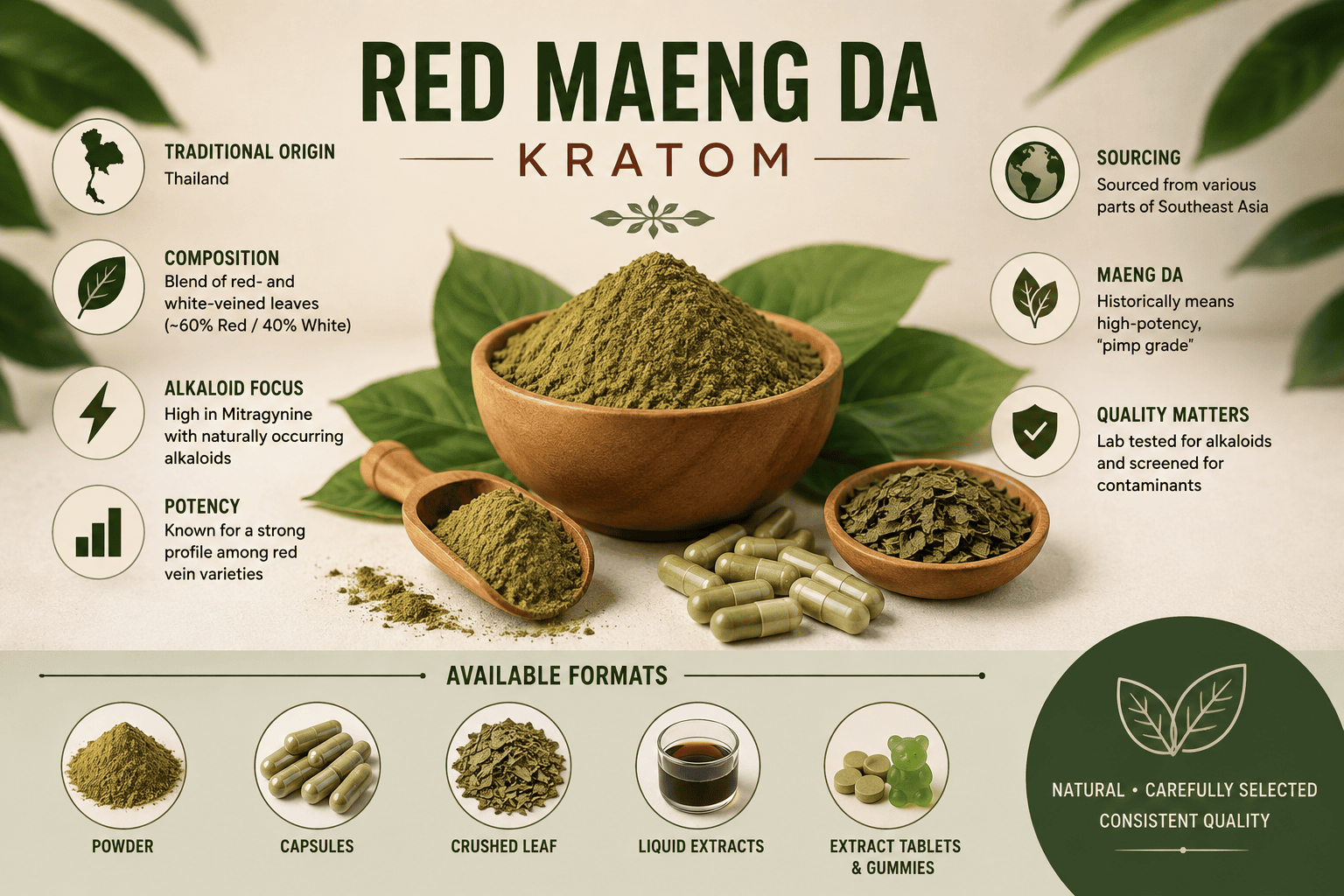
Red Maeng Da Kratom is a blend of red- and white-veined Kratom leaf powders, commonly using a ratio of around 60% red and 40% white. Because of this, it is not a traditional Kratom strain or a distinct botanical variety. However, its composition may vary from vendor to vendor.
So, what exactly makes Red Maeng Da different from other Kratom varieties? This guide breaks down what you need to know, including its origins, alkaloid composition, and available formats.
Red Maeng Da Kratom: Quick Snapshot
Traditional origin: Thailand
Modern sourcing: Various parts of Southeast Asia
‘Maeng Da’: Historically means high-potency, ‘pimp grade’
Potency: Known for the strongest profile among the red-vein varieties
Composition: Can vary by vendor and source material
Best For: Best suited to seasoned users
Table Of Contents:
What Is Red Maeng Da Kratom?
Red Maeng Da Kratom Alkaloid Profile
How Is Red Maeng Da Kratom Made?
What Are the Available Formats?
How Does Red Maeng Da Kratom Differ From Green And White Maeng Da
Red Maeng Da Vs Other Red Vein Kratom Varieties
What Is Red Maeng Da Kratom?
Red Maeng Da Kratom isn’t a single, fixed traditional strain. Historically, Maeng Da has been associated with selective grafting techniques in Thailand, while modern Red Maeng Da is typically marketed as a blend of red- and white-veined Kratom leaf powders.
Red Maeng Da Kratom Alkaloid Profile
Like other Mitragyna speciosa products, Red Maeng Da contains a complex mix of naturally occurring alkaloids. More than 40 alkaloids have been identified in Kratom, although only a smaller group occurs in relatively higher concentrations.
Mitragynine: The predominant alkaloid, accounting for roughly 60% to 66% of total alkaloids in some reported profiles.
Paynantheine: One of the more abundant secondary alkaloids.
Speciogynine: Another major secondary alkaloid found in Kratom.
Speciociliatine: Present in smaller concentrations.
Other alkaloids: Include corynantheidine, corynoxine A and B, isopaynantheine, and mitraciliatine.
How Is Red Maeng Da Kratom Made?
Red Maeng Da is typically prepared through several stages, from harvesting and drying the leaves to grinding, blending, and quality testing. The exact process can vary by supplier and production facility.
1. Leaf Selection & Harvesting
Mature Mitragyna speciosa leaves are harvested and selected for drying.
2. Washing & Preparation
Fresh leaves are cleaned to remove dirt and other foreign material. Stems and larger veins may also be removed before further processing.
3. Drying & Curing
The prepared leaves are dried in open air, often under sunlight. Drying conditions can influence the leaf’s color and chemical composition.
4. Milling
Once sufficiently dry, the leaves are ground into a fine powder. The resulting particle size can vary depending on the milling equipment and processing method.
5. Blending
This is where Red Maeng Da differs from a single-leaf product. Vendors may combine red- and white-veined Kratom powders according to their own formulations.
6. Quality Testing & Packaging
Once blended, batches undergo laboratory testing for alkaloid content and contaminants such as heavy metals and microbial contamination. Products are then packaged as powders, capsules, or other finished formats.
Note: No single standardized manufacturing process exists for Red Maeng Da Kratom powder and even other formats. Harvesting, drying, blending ratios, testing practices, and final alkaloid profiles can differ between suppliers.
What Are the Available Formats?
Red Maeng Da is available in several formats, from traditional leaf powder to capsules and concentrated Kratom products. The most common options include:
Powder: Dried Kratom leaves ground into a fine powder. This is one of the most common formats.
Capsules: Kratom powder enclosed in gelatin or vegetarian capsules for convenient, pre-portioned packaging.
Crushed Leaf: Coarsely cut Kratom leaves that retain a larger leaf texture compared with powdered Kratom.
Liquid Extracts: Concentrated Kratom preparations available in liquid form.
Extract Tablets & Gummies: Solid formats made using concentrated Kratom extracts and available in tablet or gummy form.
Note: The concentration, ingredients, and specifications can vary considerably between products and vendors, particularly with extracts and other concentrated formats.
How Does Red Maeng Da Kratom Differ From Green And White Maeng Da
Red, Green, and White Maeng Da differ primarily by processing methods, blend formulations, and alkaloid composition. Here's a side-by-side comparison of the three varieties.
Feature | Red Maeng Da | Green Maeng Da | White Maeng Da |
Primary Process | Mature leaves are sun-dried & fermented | Middle-aged leaves are air-dried indoors with little to no light | Young leaves are dried in open air with controlled conditions |
Typical Composition | ~60% Red / 40% White | ~80% Green / 20% White | ~70% White / 30% Green |
Alkaloid Focus | High Mitragynine | Balanced alkaloid profile | Mellow and mild profile |
Best Time Of The Day | Evening or nighttime | Daytime transition/beginner | Early morning |
Red Maeng Da Vs Other Red Vein Kratom Varieties
Red Maeng Da differs from other Red-Vein Kratom varieties mainly in its commercial formulation, geographic associations, and processing methods. The table below highlights the key distinctions.
Feature | Red Maeng Da | Red Malay | Red Kali | Red Borneo | Red Bali |
Origin | Traditionally associated with Thailand; now sourced across Southeast Asia | Malaysia | Kalimantan, Borneo | Borneo | Commonly marketed under the Bali name, though often sourced from Borneo |
Alkaloid Profile | Primarily Mitragynine, with other naturally occurring alkaloids | Mitragynine with minor alkaloids such as speciociliatine, speciogynine, and paynantheine | Mitragynine alongside speciociliatine, speciogynine, and other minor alkaloids | Mitragynine with speciociliatine, speciogynine, and other minor alkaloids | Naturally occurring Kratom alkaloids |
Processing | Commonly formulated by blending red- and white-veined powders | Typically marketed as a red-vein variety | Traditionally associated with prolonged drying | Typically processed as a red-vein product | Commonly associated with harvesting and drying mature leaves |
Commercial Format | Often sold as a formulated blend, which comes in powder, capsules, shots | Typically available in powders, crushed leaf, capsules, liquid shots | Typically available in powders, capsules, extracts | Available as powder and other formats | Widely available as powder and capsules |
How To Choose A High-Quality Red Maeng Da Kratom?
Quality can vary between Red Maeng Da products, so it helps to look beyond the strain name. Focus on testing, transparency, packaging, and product consistency when comparing options.
Start with testing: Prioritize products backed by recent third-party lab results.
Look for verified vendors: An AKA GMP Qualified Vendor designation can provide an additional quality benchmark.
Inspect the label: Check for clear ingredients, batch details, net weight, and manufacturer information.
Assess product consistency: The powder should have a uniform, finely milled appearance without obvious foreign material.
Check the packaging: Choose properly sealed packaging with clear product identification and traceable batch information.
Compare customer feedback: Recent reviews can offer useful insight into consistency across different batches.
Frequently Asked Questions
1. What is Red Maeng Da Kratom good for?
Some Reddit users describe Red Maeng Da as a relaxing or calming Kratom variety. However, these are individual user reports, not established effects, and experiences can vary.
2. Red Maeng Da Kratom Powder or Capsules, which one is more potent?
Neither is inherently more potent. Kratom capsules typically contain the same powder used in loose form, so the potency is determined by the powder itself rather than the format. The main difference is how the product is packaged and measured.
3. Can Red Maeng Da Kratom vary between batches?
Yes. Natural alkaloid concentrations can vary between batches because of differences in plant material, growing conditions, geographic origin, and processing.
4. Does the color of Kratom determine its alkaloid content?
Not necessarily. Leaf color and processing can be associated with differences in chemical profiles, but color alone cannot reliably determine the alkaloid content of a specific product.
5. Can I buy Red Maeng Da Kratom from a gas station near me?
Red Maeng Da Kratom may be available at some gas stations and convenience stores, but availability varies by location. If purchasing locally, check the product label, ingredients, and testing information before buying.
6. What is the legal age to buy Red Maeng Da Kratom?
The legal age to purchase Red Maeng Da Kratom varies by state and local regulations. Depending on the location, buyers may need to be 18 or 21. Always check your local laws before purchasing.
7. Can I buy Red Maeng Da Kratom online?
Yes, you can buy Red Maeng Da Kratom online from trusted vendors such as Durity Distribution. We offer competitive prices, a wide selection of Kratom products, and quality-focused sourcing to make online purchasing simple and convenient.
Related Reads:
Disclaimer: The information provided in this guide is for educational and informational purposes only and should not be considered medical or professional advice. Kratom laws and regulations vary by state and locality, so check your local laws before purchasing or possessing Kratom. Product composition and alkaloid content may also vary between vendors and batches. Always review product labels and available laboratory testing information before making a purchase.